



TRADE DIPLOMACY
Sialkot’s Billion-Dollar Ambition: Forging a New Industrial Destiny
Sialkot is emerging as a catalyst for Pakistan’s industrial transformation, with business leaders urging a shift from low-cost manufacturing toward technology, skills, branding and high-value exports. Stronger Germany ties, GSP+ access and institutional cooperation could help strengthen Pakistan’s global competitiveness and export potential.

By AHMED SHAHAB
In the heart of Pakistan’s export-oriented industrial landscape, where the rhythmic clatter of machinery has long been the soundtrack to ambition, a significant gathering in Sialkot highlighted a potentially important shift in the country’s industrial narrative.
On 8 August 2026, the German-Pakistan Chamber of Commerce and Industry (GPCCI) hosted its first-ever Business Networking Reception in Sialkot in collaboration with the Pakistan Readymade Garments Manufacturers and Exporters Association (PRGMEA). The event brought together government representatives, trade association leaders, exporters and members of Sialkot’s business community to discuss stronger Pakistan-Germany economic and commercial links.
More than a ceremonial gathering, the reception provided a platform for discussing how Pakistan’s export-oriented industries can move beyond price-based competition and develop stronger capabilities in technology, skills, product development, compliance and international branding.
From Low-Cost Manufacturing to High-Value Production
For decades, Pakistan’s industrial and export strategy has relied significantly on cost competitiveness. While this approach has helped Pakistani manufacturers enter international markets, intense global competition has also placed pressure on margins and made technological upgrading and product differentiation increasingly important.
Sialkot’s own industrial history, however, demonstrates the ability of Pakistani entrepreneurs to adapt. The city has developed internationally recognized clusters in sporting goods, surgical instruments, leather products, apparel and other export-oriented industries.
Speaking at the GPCCI reception, Federal Minister for Planning, Development and Special Initiatives Ahsan Iqbal urged Sialkot’s exporters to set ambitious targets, adopt modern technology and move from low-cost production towards high-value, internationally recognized brands.
He also highlighted the potential for a complementary Pakistan-Germany partnership in engineering, technology, manufacturing and technical education. According to reports of his remarks, he proposed incentives for companies that achieve the milestone of becoming Pakistan’s first billion-dollar export company.
The message reflects a broader challenge for Pakistan’s exporters: competing internationally cannot depend indefinitely on low prices. Technology, productivity, quality, compliance, design, innovation and brand development are increasingly central to securing higher-value markets.
Germany as a Potential Partner in Industrial Transformation
Germany offers an important reference point for Pakistan because of its internationally competitive manufacturing base, engineering capabilities and network of small and medium-sized enterprises.
Ahsan Iqbal pointed to Germany’s experience in technical education and vocational training as an area from which Pakistan could learn. A stronger connection between educational institutions, vocational training and industry could help address skills gaps and improve the employability of a young workforce.
For Pakistani manufacturers, cooperation with German companies could potentially involve technology partnerships, technical training, quality systems, manufacturing expertise, supply-chain integration and access to international business networks.
The objective would not simply be to increase the volume of exports, but to improve the value generated by each export and strengthen Pakistan’s position within global production networks.
GPCCI and PRGMEA Sign Cooperation Agreement
One of the key developments at the Sialkot reception was the signing of a Memorandum of Understanding between the German-Pakistan Chamber of Commerce and Industry and PRGMEA.
The agreement is intended to establish a framework for stronger cooperation, including the exchange of trade and investment information and the development of closer industry-to-industry links.
PRGMEA Chairman (North Zone) Imran Salahuddin and GPCCI President Syed Nadeem Ali Kazmi signed the agreement. PRGMEA representatives emphasized the importance of stronger institutional cooperation to expand apparel exports, improve international market access and enable Pakistani manufacturers to compete in higher-value segments.
The agreement is significant because sustainable trade growth rarely depends on individual businesses alone. Chambers, trade associations, government institutions and industry networks can help exporters obtain market information, understand regulatory requirements and identify potential international partners.
GSP+ and the European Market
Germany’s role in Pakistan’s European trade ambitions was also highlighted through remarks from German Ambassador to Pakistan and GPCCI Patron-in-Chief Ina Lepel.
In a recorded message, Ambassador Lepel emphasized the continuing importance of Pakistan’s GSP+ status for Pakistan-Germany economic relations. She also acknowledged the resilience of Pakistan’s business sector while noting the importance of continued work on GSP+ issues.
Pakistan’s GSP+ access has been an important element of its trade relationship with the European Union. Former Federal Minister for Commerce Khurram Dastgir Khan recalled Pakistan’s efforts to secure GSP+ status in 2014 and urged trade associations to help smaller exporters gain greater access to European markets.
For smaller manufacturers, access to European markets involves much more than finding buyers. Exporters must meet requirements related to quality, documentation, labour standards, environmental practices, product safety and other applicable regulations.
This makes institutional support particularly important for small and medium-sized businesses seeking to move into higher-value international markets.
Forward Sports and the Global “Made in Pakistan” Story
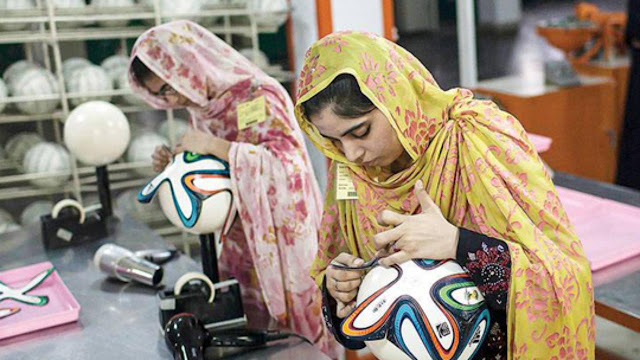
The reception also highlighted an example of Sialkot’s ability to compete on the global stage: Forward Sports, a Sialkot-based manufacturer, was congratulated for producing footballs for the FIFA World Cup 2026.
The development provides a powerful example of how Pakistani manufacturing can participate in globally recognized supply chains where quality, precision and production standards are critical.
Sialkot’s sporting-goods industry has already established a strong international reputation. The challenge now is to replicate that success across more sectors and move from manufacturing for international companies towards developing Pakistani-owned brands with global recognition.
That transition would require sustained investment in product design, research and development, technology, marketing, intellectual property, quality management and international distribution.
Sialkot Takes a More Prominent Place in Pakistan’s Export Strategy
The GPCCI reception also reflected a deliberate effort by the chamber to expand its engagement beyond Pakistan’s traditional metropolitan business centres.
GPCCI President Syed Nadeem Ali Kazmi said the chamber’s activities were being extended beyond Karachi, Lahore and Islamabad, while inviting Sialkot’s industrialists and exporters with German business interests to join the chamber and use its platform to develop trade and investment links.
This outreach is important because Pakistan’s industrial strength is not concentrated in its largest cities alone. Sialkot, Faisalabad, Gujranwala, Multan and other industrial centres contain extensive manufacturing capabilities and entrepreneurial networks that can contribute to export diversification.
Greater engagement between these industrial clusters and international chambers could create opportunities for business matchmaking, investment, technology transfer and market access.
Building Skills Alongside Factories
Technology-driven industrial development requires more than machinery. It also requires people capable of operating, maintaining and improving increasingly sophisticated production systems.
Germany’s vocational and technical education model was highlighted during the discussion as one possible area of cooperation. Stronger links between vocational institutions and industry could help Pakistan develop workers and technicians whose skills correspond directly with the requirements of modern manufacturing.
For Sialkot, this could be particularly relevant as businesses seek to improve automation, quality control, production efficiency, product development and compliance with international standards.
From Export Volume to Export Value
The central message emerging from the Sialkot gathering was therefore broader than a single trade agreement.
Pakistan’s next stage of industrial development may depend increasingly on its ability to move from competing primarily on cost to competing on value.
That means investing in:
-
Advanced manufacturing technology
- Technical and vocational skills
- Product research and development
- Quality and international compliance
- Pakistani-owned global brands
- Digital marketing and international distribution
- Stronger industry-government coordination
- Access to European and other high-value markets
- Technology partnerships and foreign investment
Such a transition would not happen overnight. It would require consistent policies, investment, institutional cooperation and a long-term commitment from both the public and private sectors.
A New Industrial Ambition for Sialkot
Sialkot’s industrial story has always been built around entrepreneurship, specialization and export orientation. The city’s next challenge is to convert those strengths into greater technological sophistication and higher-value international business.
The GPCCI Business Networking Reception provided a timely platform for that discussion. The proposed expansion of Pakistan-Germany business cooperation, the GPCCI-PRGMEA MoU, continued attention to GSP+ and the emphasis on technology and skills all point towards a more integrated approach to export development.
The example of Forward Sports demonstrates what can happen when Pakistani manufacturing capabilities meet demanding international markets. The larger question is whether similar success can be replicated across apparel, engineering, surgical instruments, sporting goods, technology-enabled manufacturing and other sectors.
For Pakistan, the ambition is not simply to export more. It is to create greater value from what the country produces, strengthen globally competitive companies and develop products and brands that can command recognition in international markets.
Sialkot’s billion-dollar ambition therefore represents more than a numerical target. It reflects a larger conversation about Pakistan’s industrial future — one in which technology, skills, innovation, quality and international partnerships become central to the country’s economic competitiveness.
The road from low-cost manufacturing to high-value global production will be demanding. But Sialkot’s industrial history suggests that ambition, entrepreneurship and adaptation can provide a strong foundation for the journey.
Source note: This article draws on publicly reported remarks and information concerning the GPCCI Business Networking Reception in Sialkot, including reporting by GPCCI, Dawn, Business Recorder and Associated Press of Pakistan (APP).
